the Human Rights Council has become the epicenter of a movement by certain Islamic states to curtail freedom of religious expression, under the guise of combating “defamation of religion” and “Islamaphobia.” The ultimate aim of this effort is not to protect the feelings of Muslims, but to protect illiberal Islamic states from charges of human rights abuse, and to silence the voices of internal dissidents calling for more secular government and freedom.
Thursday, 11 September 2008
Another Video from Pat
Secular Philosophy also tackle the main issue;


Intellectual arrogance
Massimo Pigliucci over at Secular Philosophy offers a considered rebuttal to notion of intellectual arrogance. I particularly liked it as he is an expert in his field and declares (rightly) that this makes him more qualified to make claims of fact than 'mere' laymen. Too often real experts are reluctant to stand on their authority for fear of appearing elitist or are frightened this might offend the listener in some way.
[snip]The reasoning, such as it is, goes like this: how dare you, Dr. X (put here any name of any scientist who dares to write for the public), claim that so many people are wrong and you and a small number of other egg-headed intellectuals are right? Who are you to declare the truth of evolution and the falsity of intelligent design? What makes you the arbiter in deciding what is science and what is bunk?
The answer is simple: I am an expert. You shouldn't trust me on car mechanics, or on civil engineering, or on market analysis. But what I have to say about science counts more than what most people have to say about it because I am a scientist and they are not.
[snip]
More damning, you are engaging in the ultimate act of arrogance: to declare something true or untrue not because you have reason or evidence, but only because it makes you feel better. May I suggest that you need a good dose of humility, and that one way to get it is to admit that the universe is not about you, and that some people out there really know more than you do, as unpleasant a thought as this may be?
Wednesday, 10 September 2008
Roman Reinactement
This here is a video promo for the Nijmegen Roman Festival which was held in August. Because I'm such a Roman history geek I thought it was great.
link
link
Some background on Fannie Mae
In summary;
Here is the cycle: The government invents something virtuous; the private market takes it over and loses hundreds of billions; the government then bails it out. This is best understood as socialized risk, privatized gain. Yes, the shareholders of Fannie Mae will deservedly lose a bundle -- it's always the shareholders who take a hit -- but the insiders who thought up subprime and the executives of Fannie Mae during the roaring '90s already made their pile.link
The LHC started up today... cool!
Nice 3 minute video of what it is.
Listening to the radio this morning the presenters where practically gasping over the 9 Billion Euro bill. I reckon that's roughly 2 aircraft carriers or about a third of a Fannie and Freddie bailout. The correct reaction should be "how wonderful to spend money on knowledge and science instead of war and greed".
Listening to the radio this morning the presenters where practically gasping over the 9 Billion Euro bill. I reckon that's roughly 2 aircraft carriers or about a third of a Fannie and Freddie bailout. The correct reaction should be "how wonderful to spend money on knowledge and science instead of war and greed".
Tuesday, 9 September 2008
Protectionism makes you rich
I don't know if Peter Mandelson is the most evil person in Europe, but I bet he's in the top 5.
link
The first goal of any society is to provide enough food and labour to sustain itself, under no circumstances should this be "outsourced", handed over to a third party or bartered away.Neoliberal economists claim rich countries got that way by removing their barriers to trade. Nothing could be further from the truth. As Ha-Joon Chang shows in his book Kicking Away the Ladder, Britain discovered its enthusiasm for free trade only after it had achieved economic dominance. The industrial revolution was built on protectionism: in 1699, for example, we banned the import of Irish woollens; in 1700 we banned cotton cloth from India. To protect our infant industries, we imposed ferocious tariffs (trade taxes) on almost all manufactured goods.
By 1816 the US had imposed a 35% tax on most imported manufactures, which rose to 50% in 1832. Between 1864 and 1913 it was the most heavily protected nation on earth, and the fastest-growing. It wasn't until after the second world war, when it had already become top dog, that it dropped most of its tariffs. The same strategy was followed by Japan, South Korea, Taiwan and almost every other country that is rich today. Within the ACP nations, the great success story of the past 30 years is the country whose protectionism has been fiercest: during the 1980s and 1990s, Mauritius imposed import tariffs of up to 80%. Protectionism, which can be easily exploited by corrupt elites, does not always deliver wealth; but development is much harder without it.
link
Monday, 8 September 2008
Hypocrisy of this Magnitude has to be Respected.
Interesting article available at Information Clearinghouse about Russia/Georgia and the West. It's by William Blum so you know it's worth reading.
So what then was the purpose of the Georgian invasion of Ossetia if not to serve the electoral campaign of John McCain, a man who might be the next US president and be thus very obligated to the Georgian president? Saakashvili could have wanted to overthrow the Ossetian government to incorporate it back into Georgia, at the same time hopefully advancing the cause of Georgia's petition to become a member of NATO, which looks askance upon new members with territories in dispute or with military facilities belonging to a nonmember state such as Russia. But the nature of the Georgian invasion does not fit this thesis. The Georgians did none of the things that those staging a coup have traditionally found indispensable. They did not take over a TV or radio station, or the airport, or important government buildings, or military or police installations. They didn't take into custody key members of the government. All the US/Israeli-armed and trained Georgia military did was bomb and kill, civilians and Russian peacekeeper soldiers, the latter legally there for 16 years under an international agreement. For what purpose all this if not to incite a Russian intervention?
Friday, 5 September 2008
Do these people ever listen to themselves?
More to the point, why do their supporters not care that they are such hypocritical bastards.
link from onegoodmove
link from onegoodmove
The Roma Sub Rosa Series
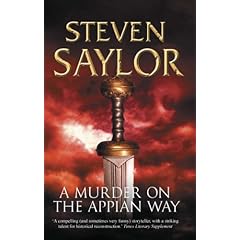 Steven Saylor's historical mysteries set in ancient Rome and featuring investigator Gordianus the Finder.
I started reading this series a few months back after borrowing the first three from a friend at work and last night I finally finished the last book. I really enjoyed the series but obviously thought some where better than others. Two of the best where "A Murder on the Appian Way" and "Catalina's Riddle" which kept me gripped and guessing right to the very end.
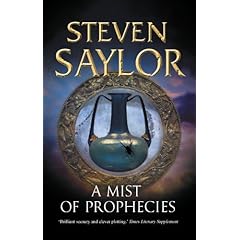 Two honourable mentions are "Venus Throw" which delivered a cracking surprise and "A Mist of Prophesis" which delved into the character of Gordianius him much more than any of the preceeding novels.
One of the great strengths of these books is the characterisation he lends to the supporting cast of famous (and not so famous) historical figures. I have read about Cicero many times but I think forever more it will be Saylors' Cicero I imagine, likewise his Catalina and Clodius. You know the author is doing a good job where you hope a doomed character won't be doomed after all. More so in a historical novel.
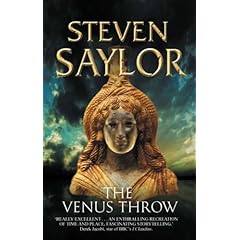 Many of the final novels deal with events surround Julius Caesar but I got the distinct impression that both the Character and Author where getting a little tired of late Roman Republic shenanigans. That's not to say I didn't enjoy them (I really did) but it might be time to start wrapping it up.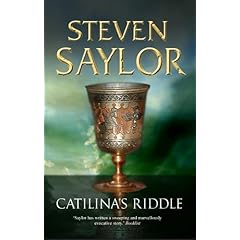
The Big Bang
Two excellent documentaries on BBC4 last night;
here's someone else's thoughts.
Lost Horizons: The Big Bang:and
To coincide with the switch-on of the LHC, the world's largest particle accelerator complex, Professor Jim Al Khalili delves into over 50 years of the BBC science archive to tell the story behind the emergence of one of the greatest theories of modern science, the Big Bang.
The remarkable idea that our universe simply began from nothing has not always been accepted with the conviction it is today and, from fiercely disputed leftfield beginnings, took the best part of the 20th century to emerge as the triumphant explanation of how the universe began. Using curious horn-shaped antennas, U-2 spy planes, satellites and particle accelerators, scientists have slowly pieced together the cosmological jigsaw, and this documentary charts the overwhelming evidence for a universe created by a Big Bang.
The Big Bang MachineNobody does it better than the BBC. Jim Al Khalili is fast becoming the Attenborough of the quantum world while the incredibly personable Cox jumps off the screen with his enthusiasm and excitement. Great stuff!
Professor Brian Cox visits Geneva to take a look around Cern's Large Hadron Collider before this vast, 27km long machine is sealed-off and the experiment to create the simulation of a black hole begins.
When it's up and running, it will be capable of creating the conditions that existed just a billionth of a second after the Big Bang. Brian joins the scientists who hope that the LHC will change our understanding of the early universe and solve some of its mysteries.
here's someone else's thoughts.
Subscribe to:
Posts (Atom)


